Understanding Project Tracking and How It Works in Xero Accounting
What is “Project Tracking”?
Project tracking is the process of monitoring and managing all aspects of a project, including:
- Time spent on tasks
- Costs and expenses
- Resources and activities
- Progress against budget
- Profitability
Why Project Tracking is Important
In business, especially in service-based or project-based industries, tracking projects is essential because it:
- Ensures projects stay within budget
- Helps deliver work on time
- Tracks profitability of each job
- Improves resource allocation
- Provides financial transparency
Without proper project tracking, businesses may lose money due to uncontrolled costs, poor time management, and lack of visibility.
What is Project Tracking in Xero?
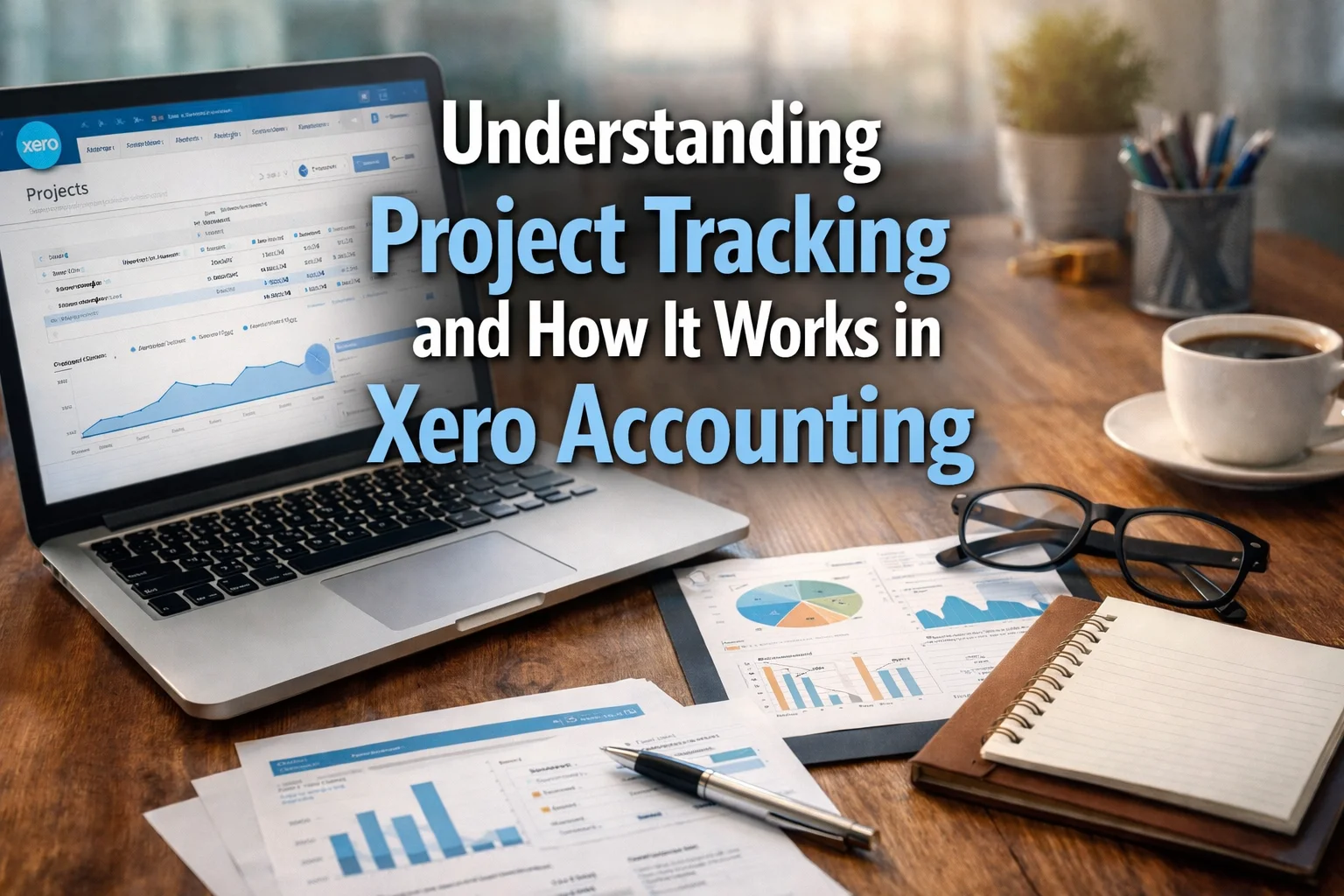
The Track Projects feature in Xero is a project accounting tool that helps businesses monitor project costs, time, budgets, and profitability in real time.
It allows users to:
- Create and manage multiple projects
- Track time and expenses automatically
- Compare actual costs vs budget
- Generate invoices directly from project data
- Analyze project profitability
In simple terms, Xero turns project management into a financially controlled and data-driven process.
Complete Guide to Xero Track Projects Feature
Introduction
Managing projects without proper tools can lead to missed deadlines, overspending, and reduced profitability. Xero solves this problem with its Track Projects feature, designed to give businesses complete control over their project finances and operations.
By combining accounting and project management, Xero helps businesses track every dollar and every hour spent on a project.
Key Features of Xero Project Tracking
1. Easy Project Setup
Xero makes it simple to start tracking projects.
Features:
- Create projects in minutes
- Add job details and descriptions
- Assign tasks and resources
Benefit:
- Quick onboarding
- No complex setup required
2. Time Tracking and Monitoring
Tracking time accurately is critical for billing and productivity.
Xero offers:
- Start–stop timer
- Manual time entry
- Mobile time tracking
Benefits:
- Real-time job insights
- Accurate billing
- Better productivity tracking
3. Expense and Cost Tracking
Xero allows you to link costs directly to specific projects.
Capabilities:
- Record project-related expenses
- Assign costs to jobs
- Track spending in real time
Result:
- Clear visibility of where money is going
- Better budget control
4. Budgeting and Cost Control
Managing budgets becomes easier with Xero.
Features:
- Set project budgets
- Compare actual vs planned costs
- Monitor spending trends
Advantage:
- Prevent overspending
- Improve financial planning
5. Project-Based Invoicing
Xero integrates invoicing directly with project tracking.
Options include:
- Fixed-price invoices
- Time-and-materials billing
- Progress-based payments
Benefits:
- Faster invoicing
- Accurate billing
- Reduced admin work
6. Real-Time Financial Dashboard
Xero provides a clear overview of project performance.
Dashboard shows:
- Revenue vs costs
- Profitability
- Project progress
Benefit:
- Quick decision-making
- Full financial visibility
7. Profitability Tracking
Understanding which projects are profitable is crucial.
Xero helps by:
- Comparing income and expenses
- Ranking projects by profitability
- Identifying high-performing jobs
Benefits of Using Xero Track Projects Feature1. Better Time Management
Track time spent on tasks and improve productivity.
2. Improved Budget Control
Monitor expenses and avoid cost overruns.
3. Real-Time Financial Insights
Access up-to-date data for better decision-making.
4. Increased Profitability
Identify profitable and loss-making projects.
5. Reduced Administrative Work
Automation reduces:
- Manual tracking
- Data entry
- Reporting effort
6. Accurate Billing
Ensure every hour and cost is billed correctly.
7. Enhanced Project Planning
Use data insights to plan future projects more effectively.
How to Use Xero Track Projects Feature
Step 1: Create a Project
- Log into Xero
- Navigate to Projects
- Add project details
Step 2: Set Budget and Scope
- Define estimated costs
- Allocate resources
- Set timelines
Step 3: Track Time and Expenses
- Use timer or manual entry
- Record expenses
- Assign costs to project
Step 4: Monitor Progress
- Check dashboard
- Compare actual vs budget
- Adjust plans if needed
Step 5: Generate Invoices
- Convert tracked time and costs into invoices
- Choose billing method
- Send to customer
Step 6: Analyze Reports
- Review profitability
- Identify trends
- Improve future planning
Common Use Cases
1. Service-Based Businesses
- Track billable hours
- Invoice clients accurately
2. Construction and Engineering
- Monitor project costs
- Control budgets
3. Freelancers and Agencies
- Manage multiple clients
- Track time and expenses
Why Businesses Choose Xero for Project Tracking
Businesses prefer Xero because it offers:
- Integration with accounting and invoicing
- Real-time financial data
- Easy-to-use interface
- Automation of repetitive tasks
- Scalability for growing businesses
Best Practices for Using Xero Projects
To maximize efficiency:
- Track time daily
- Assign all costs to projects
- Monitor dashboards regularly
- Use project reports for analysis
- Set realistic budgets
Additional Capabilities
Integration with Invoicing
Automatically convert project data into invoices.
Mobile Accessibility
Track time and costs from anywhere.
Reporting and Analytics
Generate detailed reports for better decision-making.
Conclusion
Project tracking is essential for businesses that want to control costs, manage time effectively, and maximize profitability. Xero provides a powerful Track Projects feature that combines project management with financial tracking.
With tools for time tracking, cost management, budgeting, invoicing, and reporting, Xero enables businesses to manage projects efficiently from start to finish. By using this feature, companies can improve accuracy, reduce administrative work, and make smarter business decisions.
In today’s competitive environment, having a reliable project tracking system like Xero is not just beneficial—it is a key driver of success.
Real-world example: tracking a client project end to end
Let’s make this concrete. Imagine you’re a freelance web designer who just won a $8,500 website project for a local restaurant. Here’s how that project flows through Xero’s project tracking from quote to payment:
You create the project in Xero and set a budget: $8,500 fixed price, with an internal cost budget of $5,200 (40 hours of your time at $110/hour = $4,400, plus $800 for stock photos, fonts, and a premium plugin license). You also set a deadline of 6 weeks. This budget becomes your baseline — every dollar and hour gets measured against it.
Week by week, you log time: 8 hours in week 1 (discovery), 12 hours in week 2 (design), 14 hours in week 3 (build), 6 hours in week 4 (revisions). That’s 40 hours total, exactly on budget. You also record the $800 in expenses, assigning each to the project. By week 4, Xero shows: $5,200 spent of $5,200 budgeted (100%), $8,500 quoted. Your projected margin is $3,300, or 39%.
You invoice the client for the full $8,500 on completion (or in two $4,250 milestone invoices if you prefer). When payment arrives, you close the project and review the final report: actual cost $5,200, revenue $8,500, profit $3,300. But here’s the insight — you also see that design took 12 hours vs. the 10 you estimated. Next time, you’ll quote design at 12 hours, protecting your margin. That’s the real value: not just tracking this project, but pricing the next one better.
Project tracking mistakes to avoid
First, not assigning every cost to a project. If you buy $200 in materials and forget to tag it to the project, your profit looks $200 better than it is — and you’ll underprice the next job. Second, logging time in bulk at month-end instead of daily. You won’t remember if Tuesday was 6 hours or 8 hours, and the guesswork compounds. Third, setting a budget but never checking it. A budget you don’t review is just a number; check the dashboard weekly and act when a project hits 75% of budget. Fourth, mixing project and non-project work in the same time entries. If you do 2 hours of admin and 6 hours of client work, log them separately or your project profitability is fiction. Finally, closing projects without reviewing them. The post-mortem — comparing estimated vs. actual hours and costs — is where the learning happens. Skip it and you’ll repeat the same pricing mistakes.
FAQs
Q: Does Xero project tracking cost extra? A: It depends on your plan. Project tracking (Xero Projects) is included in the Premium plan at $75/month. On Starter ($29/month) and Standard ($50/month), it’s typically an add-on or unavailable — check Xero’s current pricing page, as packaging changes. If you run project-based work, the Premium plan usually pays for itself in better pricing decisions.
Q: Can I track projects that are billed hourly vs. fixed price? A: Yes. Xero Projects supports both. For hourly work, you log time and invoice based on actual hours (time-and-materials). For fixed-price projects, you track time and costs internally to monitor your margin, but invoice the agreed fixed amount. The key is to track time even on fixed-price jobs — otherwise you won’t know if the price was profitable.
Q: What happens to project data if I cancel my Xero subscription? A: You lose access when the subscription ends. Export project reports, invoices, and time entries before canceling. Xero lets you export most data, but it’s your responsibility to do it while you still have access. Don’t wait until the last day.
Q: Can multiple team members log time to the same project? A: Yes, as long as they have Xero access with the right permissions. Each person logs their own time, and Xero aggregates it at the project level. This is essential for agencies — you see the total hours across the team, not just your own. Make sure everyone logs daily; weekly bulk entries are where accuracy dies.
Q: How is project tracking different from just using Xero’s invoicing? A: Invoicing records what you billed. Project tracking records what it COST you to deliver — time, expenses, materials — and compares that to the budget and the invoice. Without project tracking, you know your revenue but not your profit per job. With it, you know which clients and project types actually make money.